Edison LED Lighting

Projects
China Best Office Lighting Suppliers for Global Buyers
Choosing China’s best Office Lighting suppliers requires more than comparing prices, product photos, and export claims. Global buyers need dependable performance in real workplaces. A supplier should demonstrate tested illuminance, glare control, color consistency, thermal safety, and reliable delivery. Factory audits matter. So do independent reports.
Dr. Mariana Figueiro, a respected lighting researcher, has stated, “Light is the most important cue for synchronizing the circadian system.” Her observation reminds buyers that office lighting affects more than visibility. It can influence alertness, comfort, and daily working rhythms. In a supplier’s showroom, inspect the light on desks, screens, white walls, and polished floors. Notice harsh reflections. Check whether dimming feels smooth or jumps suddenly. Ask for photometric files, warranty terms, certifications, and replacement procedures.
Experience also exposes weaknesses. A bright sample may perform poorly after hours of operation. A low price may hide inconsistent drivers or limited technical support. This is where careful sourcing becomes valuable. Leading Chinese manufacturers often provide LED panels, linear fixtures, smart controls, emergency systems, and customized designs. However, “best” depends on the project, not a universal ranking.
The evidence should be practical. Request samples. Test them in your space. Compare results under daylight and evening conditions. Keep records.
Some details are easy to miss.
A reliable supplier communicates clearly when specifications change. It admits limitations instead of promising perfection. That honesty deserves attention. Global buyers should evaluate manufacturing capability, quality control, energy performance, after-sales service, and compliance documentation together. The right partner delivers comfortable, efficient Office Lighting, not merely attractive fixtures.
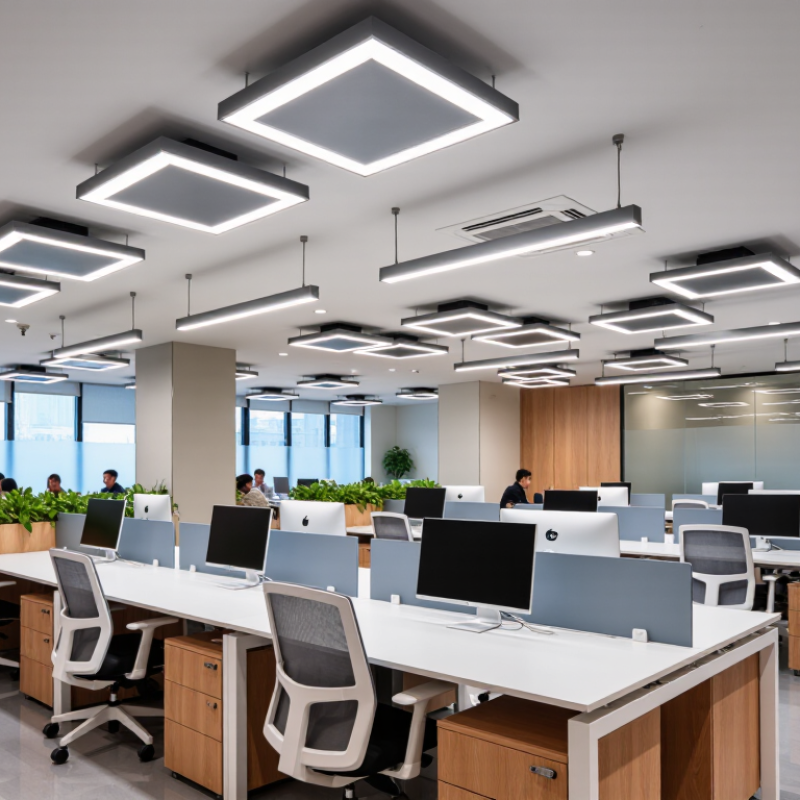
Types of Office Lighting Products Offered by Chinese Suppliers
Chinese office lighting suppliers usually offer LED panels, linear fixtures, troffers, downlights, task lights, and emergency luminaires. Panels suit open-plan ceilings, while linear systems create cleaner rows above desks and corridors. Downlights work better in meeting rooms, receptions, and smaller offices.
Not just panels.
The U.S. Department of Energy reports that LED lighting can use at least 75% less energy than incandescent lighting and last up to 25 times longer. For global buyers, product selection should include efficacy, color temperature, CRI, glare control, and lifetime testing. A 4000K panel with UGR below 19 may support comfortable office work, but actual performance depends on ceiling height, desk layout, and wall reflectance. Details matter.
Many Chinese suppliers also provide dimmable fixtures, occupancy sensors, daylight controls, and DALI or 0–10V interfaces. These systems can reduce unnecessary operating hours. The International Energy Agency has reported that lighting represents roughly 15% of global electricity consumption, so control systems deserve serious attention. Yet energy savings are often overstated when suppliers quote laboratory results only. Buyers should request LM-80, TM-21, photometric files, flicker data, and independent safety certificates. In practical sourcing, a low price can hide weak drivers, inconsistent color, or difficult replacement. I would also check sample batches, not one perfect unit. Specification sheets help, but they do not reveal every installation problem.
China Best Office Lighting Suppliers for Global Buyers – Types of Office Lighting Products Offered by Chinese Suppliers
| Office Lighting Product Type | Typical Office Applications | Common Light Source | Typical CCT | Typical System Efficacy | Available Control Options | Common Installation Method | Key Purchasing Considerations |
|---|---|---|---|---|---|---|---|
| LED Troffer Lights | Open-plan offices, classrooms, meeting rooms, and suspended ceilings | Integrated LED modules | 3,000K–6,500K | Typically 100–150 lm/W | On/off, 0–10V dimming, DALI, occupancy sensing, daylight harvesting | Recessed or surface-mounted in modular ceiling systems | Check ceiling compatibility, glare control, UGR rating, driver quality, and emergency options |
| LED Panel Lights | General office areas, corridors, reception spaces, and commercial interiors | Edge-lit or back-lit LED | 3,000K–6,500K | Typically 90–140 lm/W | On/off, 0–10V, DALI, wireless control, motion sensors | Recessed, surface-mounted, or suspended with a cable kit | Compare lumen maintenance, diffuser uniformity, flicker performance, and power factor |
| Linear LED Office Lights | Open-plan workstations, circulation areas, collaborative zones, and long corridors | Integrated LED strips or LED boards | 3,000K–5,000K | Typically 100–160 lm/W | On/off, DALI, 0–10V, sensor-based control, tunable white | Suspended, recessed, surface-mounted, or continuous-row installation | Review optical distribution, connector design, row continuity, and suspension accessories |
| LED Batten Lights | Utility offices, storage rooms, service areas, workshops, and back-of-house spaces | Integrated LED modules | 4,000K–6,500K | Typically 100–150 lm/W | On/off, microwave or PIR sensor, emergency backup | Surface-mounted or suspended | Suitable for cost-sensitive projects; check housing strength, beam angle, and sensor coverage |
| Suspended Pendant Lights | Reception desks, executive offices, meeting rooms, and feature workspaces | Integrated LED modules | 2,700K–4,000K | Typically 90–140 lm/W | On/off, dimming, DALI, 0–10V, tunable white | Suspended from the ceiling using adjustable cables or rods | Evaluate direct/indirect light ratio, glare rating, suspension length, and visual design |
| Downlights and Spotlights | Reception areas, corridors, retail-style offices, lounges, and display zones | COB LED or integrated LED | 2,700K–4,000K | Typically 80–120 lm/W | On/off, phase dimming, 0–10V, DALI | Recessed or surface-mounted | Check beam angle, cut-out size, glare control, trim finish, and ceiling depth requirements |
| Wall-Mounted Office Lights | Corridors, stairwells, waiting areas, breakout spaces, and decorative applications | Integrated LED or replaceable LED lamp | 2,700K–4,000K | Typically 70–110 lm/W | On/off, occupancy sensor, photocell, dimming | Directly mounted on walls or vertical architectural surfaces | Consider light distribution, mounting height, impact resistance, and maintenance access |
| Emergency Lighting Fixtures | Exit routes, staircases, corridors, office floors, and fire escape paths | LED with rechargeable battery system | Commonly 4,000K–6,500K | Application-dependent | Maintained or non-maintained operation, self-test, central monitoring | Wall-mounted, ceiling-mounted, or recessed | Verify local emergency-lighting regulations, rated duration, battery type, and test function |
| Exit Sign Lights | Office exits, escape routes, staircases, and public circulation areas | LED with rechargeable battery system | Typically green or red pictogram illumination | Application-dependent | Maintained or non-maintained operation, self-test, remote monitoring | Wall-mounted, ceiling-mounted, or suspended | Confirm pictogram format, viewing distance, battery duration, and applicable safety standards |
| Track Lighting | Showrooms, creative studios, reception areas, galleries, and flexible office zones | COB LED or integrated LED spotlight | 2,700K–4,000K | Typically 80–120 lm/W | On/off, phase dimming, DALI, track-based switching | Mounted on single-circuit or multi-circuit track systems | Review track compatibility, beam angle, glare control, color rendering, and aiming flexibility |
| Tunable White Office Lighting | Modern workplaces, wellness-focused offices, collaborative areas, and premium interiors | Variable-CCT LED modules | Typically 2,700K–6,500K | Typically 80–130 lm/W | DALI-2, Bluetooth, wireless controls, scene setting, daylight-linked control | Recessed, suspended, surface-mounted, or linear systems | Check control interoperability, commissioning requirements, color consistency, and system software |
| Smart Sensor-Integrated Fixtures | Energy-efficient offices, meeting rooms, corridors, and occupancy-variable areas | Integrated LED with PIR or microwave sensor | 3,000K–5,000K | Typically 90–150 lm/W | Occupancy detection, daylight harvesting, corridor function, wireless networking | Recessed, surface-mounted, suspended, or linear installation | Assess detection range, sensor commissioning, networking protocol, and privacy requirements |
Related Posts
-
How to Choose the Best Office Lighting for Maximum Productivity and Comfort
-
Exploring the Unique Features and Applications of LED Strip Lighting for Global Buyers
-
7 Essential Benefits of Using Led Track Light in Modern Interior Design
-
Challenges in Sourcing Quality Led Ceiling Lights for Your Business
-
What is the Ultimate Guide to Choosing the Best Home Lighting Solutions
-
How to Choose the Best Led Track Light for Your Space?