
Choosing the right 5-inch TFT LCD module can shape an entire product’s usability, cost, and service life. For global buyers, the decision involves more than screen size. Resolution, brightness, viewing angle, touch technology, interface type, and operating temperature can change performance significantly. A compact industrial controller may need a sunlight-readable display, while a handheld medical device may prioritize low power and stable color reproduction.
Display analyst Bob Raikes, founder of Display Daily, puts it plainly: “The display is the product’s primary interface with the user.” That principle remains practical. A clear image, responsive touch layer, and reliable connector often matter more than an impressive specification sheet. Buyers should inspect the panel under real conditions, including glare, vibration, gloves, and long operating hours. Small details matter.
This guide examines ten common types of 5-inch TFT LCD module used in industrial equipment, medical instruments, vehicle systems, smart appliances, and portable terminals. The list covers standard RGB modules, IPS panels, resistive-touch versions, capacitive-touch displays, high-brightness models, and sunlight-readable designs. It also considers interfaces such as RGB, MCU, SPI, and MIPI, because compatibility problems can appear late and become expensive. Some classifications overlap, which is worth admitting. Manufacturers may describe one module by its panel technology and another by its touch function. That inconsistency can confuse international sourcing. Careful comparison is still necessary. A promising module may fail because its backlight connector, firmware support, or supply continuity was overlooked.
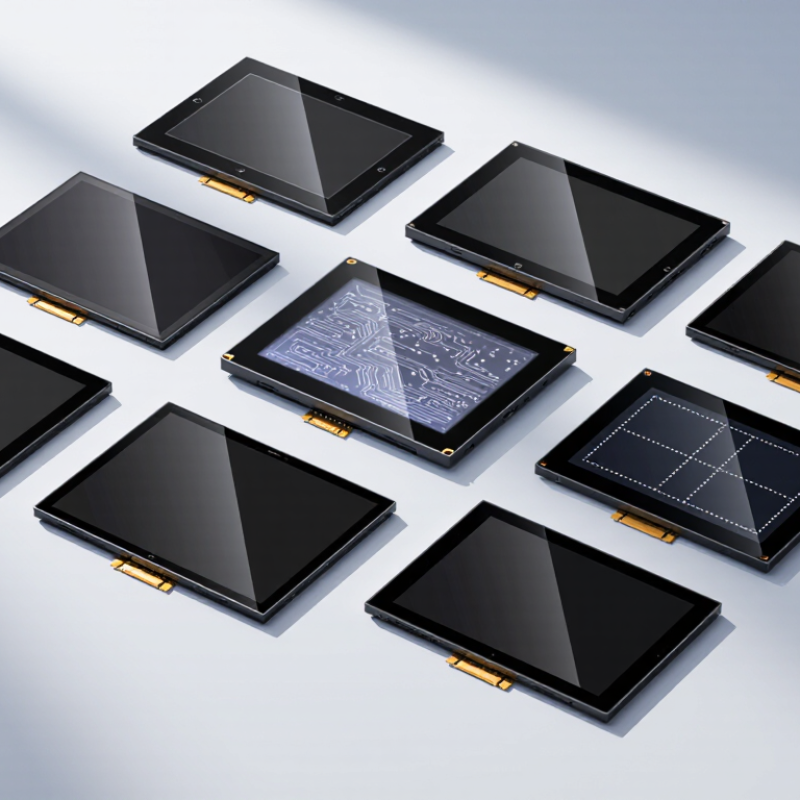
A 5-inch TFT LCD module is an active-matrix display with five inches measured diagonally. Each pixel uses thin-film transistors to control light, color, and response. Omdia’s 2024 display outlook indicates that LCD still represents more than 80% of shipped display area. This explains its strong position in industrial equipment, transport panels, and handheld instruments.
Buyers can classify 5-inch modules in ten practical ways: TN or IPS; transmissive or transflective; standard or high brightness; 480×272, 800×480, or 720×1280 resolution; RGB or RGBW color layout; resistive or capacitive touch; parallel RGB, SPI, or MIPI interface; standard or wide temperature range; portrait or landscape orientation; and bare, touch-integrated, or cover-glass construction. A 2024 MarketsandMarkets report expects the global display market to keep expanding through 2029, but module growth does not guarantee easy replacement. Connector position, active-area tolerance, and firmware timing can still cause failures.
Tips: Request the full mechanical drawing, not only a product photo. Check viewing angle at the actual mounting direction. Measure brightness after touch glass installation. IEC 61747-related test records can improve supplier evaluation, although they do not replace sample testing. One overlooked issue is cable bending near the connector. It can pass a bench test and fail during assembly. I would also compare sunlight readability, not only the advertised luminance. Cheap choices sometimes become expensive choices.
A 5-inch TFT LCD module can look simple, but its display technology changes cost, readability, and power use. Ten common types serve different applications. They include TN TFT, IPS TFT, wide-viewing-angle TFT, LTPS TFT, oxide TFT, transflective TFT, high-brightness TFT, sunlight-readable TFT, AMOLED, and PMOLED. Most industrial buyers still choose LCD for stable supply and predictable pricing. OLED remains attractive when deep blacks, thinness, and high contrast matter.
Omdia’s 2024 display outlook indicates that LCD will remain dominant by display area through 2030. DSCC’s 2024 OLED Display Technology and Market Outlook also estimated more than 800 million OLED smartphone panels in 2024. These figures show market strength, not automatic suitability for a 5-inch product. TN offers fast response and lower cost, but narrow viewing angles remain a weakness. IPS improves viewing consistency. LTPS supports higher pixel density, while oxide TFT can reduce leakage current. Transflective panels suit equipment used indoors and outdoors. High-brightness versions need careful thermal testing.
Tips: Compare luminance, contrast, viewing angle, interface, and operating temperature. Ask for sunlight testing, not only a laboratory brightness value. Check the backlight lifetime and touch performance with gloves. A “wide-viewing-angle” label may hide uneven color at extreme angles. I have seen specifications look excellent on paper, yet the screen washed out beside a warehouse window. Real installation tests still matter.
Choosing among ten common 5-inch TFT LCD module types requires more than checking screen size. In practical integration work, I compare resolution, active area, viewing angle, brightness, and contrast. An 800 × 480 panel may suit a compact controller, while 1280 × 720 displays sharper maps and menus. Pixel density matters when operators read small labels. Check it under real lighting. Indoor brightness can look weak beside a sunlit window. For outdoor equipment, 500–1,000 cd/m² may be safer, although power consumption increases.
Interface compatibility can prevent expensive redesigns. Review RGB, SPI, MIPI, or other connection requirements before ordering samples. Confirm logic voltage, connector position, cable length, and controller support. A capacitive touch layer feels modern, but gloves, moisture, and thick cover glass can reduce accuracy. Resistive touch can be more practical for tools and industrial panels. Small details matter.
Panel technology also affects reliability. IPS usually offers wider viewing angles, while TN designs may reduce cost and response time. Check operating temperature, storage temperature, lifetime, backlight uniformity, and response time. Mechanical drawings should include bezel size, mounting holes, and total thickness.
I once treated the listed dimensions as sufficient and missed the rear connector clearance. That mistake delayed enclosure testing.
Do not trust a specification sheet alone. Request samples, inspect white uniformity, test touch behavior, and measure current during startup. Long-term availability deserves attention too, because a lower initial price is useless if the module changes during production.
A 5-inch TFT LCD module can suit very different working environments. The categories are not perfectly separate, but each design supports a practical application. Standard modules fit handheld meters, vending controls, and compact office equipment. Resistive touch versions work well with gloves, probes, or dusty factory panels. Projected capacitive models suit kiosks, smart appliances, and portable control terminals. IPS modules provide stable colors for inspection screens, dashboards, and operator interfaces viewed from different angles.
Sunlight-readable modules serve outdoor payment terminals, transport displays, and agricultural instruments. High-brightness versions improve visibility near windows, though they may consume more power. Wide-temperature modules are useful in refrigeration controllers, roadside equipment, and warehouse vehicles. Ruggedized modules support construction tools and mobile diagnostic units where vibration is common. Automotive-oriented modules fit rear-seat controls, navigation panels, and vehicle monitoring systems, but temperature and interface requirements need careful checking. Medical-use modules can display patient monitors, laboratory instruments, and portable examination equipment; the complete device still needs appropriate safety validation. Smart-display modules combine touch control and processing for home automation panels and connected appliances.
In practice, a bright screen can still disappoint outdoors. Cover glass, bonding, viewing angle, and software layout matter too. I have seen buyers compare only resolution and miss connector stability. That mistake costs time. Engineers should test the module with the final enclosure, gloves, lighting, and power supply. Some applications need custom firmware or unusual mounting holes. Others need only a reliable standard panel. Performance depends on the whole assembly, not the LCD alone.
Selecting a 5-inch TFT LCD module starts with the end product, not the catalog. Mordor Intelligence’s 2024 TFT LCD market analysis projects annual growth above 3% through 2029. That growth increases supplier choices, but also increases comparison risks. Define viewing angle, brightness, resolution, interface, and operating temperature before requesting quotations. A 5-inch screen for outdoor equipment may need 800 cd/m² brightness, while an indoor controller may need far less.
Check the electrical details carefully. Confirm the connector pitch, signal timing, input voltage, backlight current, and touch-panel compatibility. LVDS, RGB, and MIPI interfaces are not interchangeable without design changes. Omdia’s 2024 display supply-chain research highlights continuing pressure on panel pricing and capacity planning. Therefore, ask for quarterly capacity information, not only today’s unit price. Request samples from the intended production line. Sample quality can mislead.
The International Energy Agency reported nearly 14 million electric cars sold globally in 2023, showing why compact displays increasingly face vibration and temperature demands. For vehicle or industrial use, request thermal cycling, vibration, humidity, and lifetime test records. Also verify RoHS and REACH documentation. I have seen buyers focus heavily on pixel count. They later discover weak sunlight readability or a fragile FPC. That mistake is avoidable, but not always. A supplier’s written response matters more than a polished presentation. Include inspection criteria, warranty terms, change-notification procedures, and a realistic end-of-life plan in the purchasing agreement.
WhatsApp us