Edison LED Lighting

Shop

Projects

How to Find a Reliable LED Light Supplier in 2026?

Finding a reliable Led Light Supplier in 2026 takes more than comparing unit prices. Buyers need to check product performance, production consistency, documentation, and after-sales support. A low quote can look attractive beside a sample that feels solid and evenly lit. The real test is whether later batches match it.

The U.S. Department of Energy’s Energy Saver guidance says LED bulbs use up to 90% less energy than traditional incandescent bulbs. Its long-life potential makes product quality and accurate performance claims especially important. The IEA’s Energy Efficiency 2023 report also identifies efficiency improvements as an important tool for managing energy demand. These reports offer useful context, but they cannot verify a supplier’s factory or shipment. That still takes due diligence.

This guide explores practical ways to assess suppliers: reviewing certifications and test reports, checking warranty terms, requesting production samples, and asking how defects are handled. Look closely at details such as color consistency across a row of fixtures, clear model numbers, and realistic delivery schedules. Small checks matter. A polished website is not proof of reliable manufacturing, and one sample cannot guarantee every order. Even experienced buyers can miss a weak point; that deserves reflection, not guesswork. The goal is a supplier whose evidence, communication, and delivered products hold up under scrutiny.
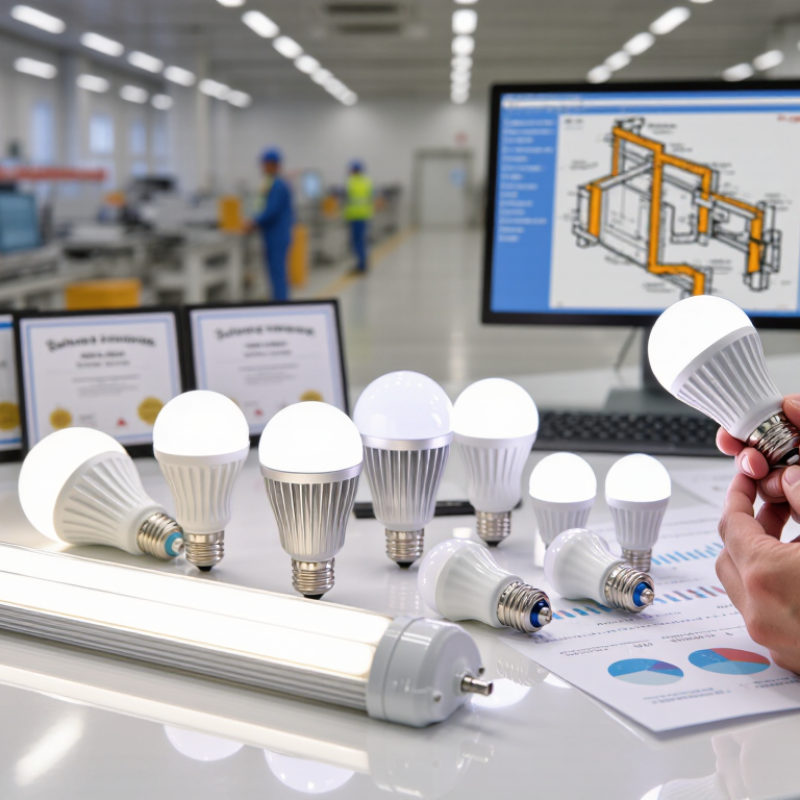
How to Find a Reliable LED Light Supplier in 2026?

Set Performance Targets for Efficacy (lm/W), CRI, and CCT

When comparing LED suppliers, set a delivered-luminaire efficacy target, not just a chip-level figure. The U.S. Department of Energy’s 2022 Solid-State Lighting R&D Opportunities report notes commercial LED products exceeding 150 lm/W, but optics, drivers, and thermal design affect fixture output. Ask for test reports showing luminaire lumens divided by input watts, with the tested configuration clearly identified. A catalog number alone is not evidence. Measure the real fixture.

For color, use CRI 80 as a basic screening floor; ENERGY STAR’s lamp requirements use this threshold for general color rendering. For retail, healthcare, or accurate material inspection, request higher CRI and IES TM-30 data, including Rf and Rg, since one CRI number can hide weak reds or oversaturated colors.

Specify CCT by use: 2700–3000 K for warm residential spaces, around 3500–4000 K for neutral work areas, and higher values only when the visual task supports them. Review samples in the actual room; wall colors and dimming can shift perception. I would not lock CCT from a spreadsheet alone. Supplier data may be measured under ideal conditions, so compare independent test reports and confirm performance at the intended operating temperature.

Check Supplier Quality Systems and IEC 60598 Safety Compliance

A reliable LED light supplier should be able to show how quality is controlled, not just promise that every unit is tested. Ask for its quality procedures, inspection records, and a sample production report. Look for clear incoming checks on LED modules, drivers, wiring, and housings. Useful records connect component batches to finished-product lot numbers. Small details matter.

Check whether the supplier’s IEC 60598 test documentation covers the exact luminaire model you plan to buy. IEC 60598-1 sets general safety requirements, while relevant sections of the series address particular luminaire types. Compare the model number, rated voltage, construction, and intended use on the report with your product specification. A report for a similar-looking fixture is not enough. Confirm who performed the testing and whether the report remains applicable after design changes.

Ask how the factory handles a failed inspection, a new component, or a revised driver. Request evidence of corrective actions and production checks, such as wiring inspections or protective-earth continuity tests where applicable. Also confirm which national requirements apply in your sales market; IEC documentation alone may not meet every local requirement. Paperwork can look tidy while production varies. I would want to review a recent batch record, though one record cannot prove every future batch will be consistent.

How to Find a Reliable LED Light Supplier in 2026? — Check Supplier Quality Systems and IEC 60598 Safety Compliance

Assessment area Evidence to request How to verify it Reliable-supplier signal
Quality management system A current quality-management-system certificate, its scope, issuing body, and certification status. Check the certificate directly with the certification body or its official verification service. Confirm that the certified site and activities cover the products being supplied. The certificate is valid and its scope matches the manufacturing or quality activities relevant to the order. A management-system certificate is not product safety approval.
IEC 60598 safety coverage The applicable IEC 60598-1 general-requirements report and the relevant IEC 60598-2 particular-requirements report for the luminaire type, where applicable. Confirm the standard part and edition, intended product type, test laboratory, report date, and any national adoption or market-specific requirements. Ask whether amendments or newer editions affect the target market. The documents cover the actual luminaire design and intended use. IEC standards define requirements; citing IEC 60598 alone does not prove that a product is certified or compliant.
Report-to-product traceability Test reports, product photographs or drawings, model identifiers, and a list of covered variants. Match the report’s model, construction, rated input, insulation class, and relevant components to the offered product. Request written confirmation of which variants are covered. The supplier can explain any differences between tested and offered configurations and provides a controlled process for reviewing design changes.
Electrical and thermal safety controls Relevant safety test results and design information for electrical protection, insulation, temperature rise, and enclosure or ingress protection claims when applicable. Check that claims correspond to the product’s installation conditions and intended environment. Verify that any stated IP rating is supported by applicable test evidence. Safety claims are supported by product-specific evidence, not only by a component certificate or a general marketing statement.
Production inspection and testing Documented incoming, in-process, and final inspection procedures; test records; and acceptance criteria. Review a sample of recent, suitably redacted records. Ask how nonconforming products are identified, segregated, corrected, and prevented from shipping. Records are traceable to production batches, and the supplier can describe corrective-action and release controls.
Component and material control Bills of materials, approved-component lists, supplier-change records, and applicable component documentation. Ask how changes to drivers, LED modules, wiring, insulation materials, or other safety-relevant parts are assessed and approved before production. Safety-relevant substitutions are controlled, documented, and reviewed for their effect on the product’s test evidence and compliance.
Market-specific approvals and labeling Applicable conformity documents, declarations, labels, and instructions for each destination market. Identify the importing country and product category first, then check the applicable legal requirements and whether the supplied documents match the exact model. The supplier distinguishes voluntary test evidence from legally required market approvals and does not present one market’s documentation as universal approval.
Change control and ongoing compliance A written process for design changes, production-site changes, periodic review, and customer notification. Ask what triggers reassessment or retesting and how the supplier informs customers when a change could affect safety, performance, or regulatory documentation. Changes are recorded, assessed before implementation, and linked to the affected models and compliance documents.
Document review before purchase A model-specific document pack, including applicable reports, technical specifications, installation instructions, and warranty terms. Check consistency across model numbers, ratings, product photos, reports, labels, and quotation. Resolve discrepancies in writing before approving production. Documents are complete, consistent, current for the intended market, and provided early enough for review—not only after shipment.

Note: IEC 60598-1 contains general requirements for luminaires, while the applicable IEC 60598-2 part addresses particular luminaire types. Confirm the current applicable editions and local regulatory requirements for the destination market.

Review LM-80 Reports Covering at Least 6,000 Hours of Testing

A reliable LED light supplier should provide more than a lifespan figure on a product sheet. Ask to review the LM-80 report for the LED package, module, or array used in the product. Check that testing covers at least 6,000 hours and identifies the tested device, drive current, and temperature. These details help you judge whether the data applies to the product you are considering.

Look for consistent measurements across the report, not just a promising final number. LM-80 tracks lumen maintenance and color shift under specified conditions; it does not test the complete light fixture. A supplier should explain how the test conditions relate to real use and how any projected lifetime was calculated. Projections may use TM-21 methods, but they are not a substitute for measured test hours. I would still ask questions if the report looks polished but the product match is unclear.

Tips: Match the report’s LED model to the supplier’s bill of materials, and request the full document rather than a cropped chart. Check test hours, temperatures, and current. Then ask what happens if components change. A clear answer matters.

Validate TM-21 L70 Projections and Rated Operating Life

How to Find a Reliable LED Light Supplier in 2026?

Ask for the full IES LM-80 test report and matching TM-21 calculation, not just a catalogue claim such as “L70: 100,000 hours.” LM-80 measures lumen maintenance for LED packages, modules, or arrays under controlled conditions. The IES method uses at least 6,000 hours of test data; 10,000 hours is preferred. Longer tests give projections a firmer basis. Still, projections are not guarantees.

TM-21-21 extrapolates LM-80 results within prescribed limits. It does not certify a complete fixture or predict every component failure. The U.S. Department of Energy’s 2011 report, LED Luminaire Lifetime: Recommendations for Testing and Reporting, distinguishes lumen depreciation from catastrophic failure. That distinction matters. A light may retain 70% of its initial output while its driver or another part has already failed.

Check whether the projection matches the exact LED package and operating temperature in the proposed product. Request the test temperature, drive current, sample details, and calculation method. Then compare them with your real conditions: a warm ceiling void is not a cool laboratory. Ask how the supplier defines rated operating life and what evidence supports it. I’ve seen impressive numbers with little context. Numbers need context.

Assess IEC 62471 Photobiological Risk and Warranty Terms

A reliable LED supplier should provide an IEC 62471 photobiological safety report for the exact light model you plan to buy. Do not rely on a generic certificate or a catalog image. Ask which risk group applies and under what test conditions, including distance, output, and exposure time. Ask for the report. A fixture’s risk classification can change with how it is used, so match the test setup to your installation.

Check that the report identifies the product clearly and explains relevant hazards, such as blue-light exposure or ultraviolet output. For a high-bay light, for example, the viewing distance and mounting height matter. Compare the report with the datasheet and sample label; mismatched model numbers deserve a written explanation. I would not treat a risk-group label as a substitute for practical assessment. It is easy to overlook the difference between a test result and a real work environment.

Warranty terms need the same close reading. Confirm the coverage period, start date, and whether it applies to the driver, LEDs, and labor. Ask what evidence a claim requires, who pays shipping, and whether repair or replacement is offered. Get exclusions in writing, including limits tied to heat, moisture, or unsuitable dimmers. Vague wording is a warning. Even a detailed warranty can disappoint if claim handling is slow, so request a typical response time and keep the reply with your purchase records.